Calling all gardeners, foodies, and critical inquirers! On this episode of TTT meet teachers who have been developing amazing projects around food. We are joined by Joseph Franzen and Brent Peters along with one of their students, Devin Brown. In additon Lauren Goldberg, Elfe Dona, and Karen Fasimpaur add to this rich conversation about what happens when we focus on the relationships students have with food.
Here are a couple of teasers:
Before becoming an English teacher and Bread Loaf student, Brent Peters worked as a chef at the Mayan Café in Louisville, Kentucky. Joe Franzen has been an urban gardener, sustainability enthusiast, environmental educator, and kitchen magician for years. He has turned Fern Creek Traditional High School into an "edible campus."
We'd love to hear how your students have used food, gardening, and critical inquiry in their learning. What a rich place this is for learning -- for all of us!
Click Read more to see the chat that was happening during this live webcast, and to find links to a few of the resources shared during this episode of TTT.
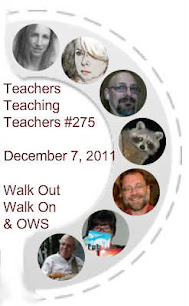
We begin a conversation about Margaret Wheatley’s and Deborah Frieze’s book, Walk Out Walk On [ http://walkoutwalkon.net ], and we explore how the Occupy movements and Educamps might reflect some of the principles in this book.
We begin a conversation about Margaret Wheatley’s and Deborah Frieze’s book, Walk Out Walk On [ http://walkoutwalkon.net ], and we explore how the Occupy movements and Educamps might reflect some of the principles in this book.
Monika Hardy wrote recently that she is “absolutely swimming in Walk Out Walk On.” She goes on to explain:
We have been working on a quiet revolution the last four years in Colorado [ http://labconnections.blogspot.com ], both outside and in the public school system, in order to create the communities the authors, Margaret Wheatley and Deborah Frieze share and describe so poignantly, so beautifully in their book.
Mary Ann Reilly joins us this week. Mary is also be inspired by Walk Out Walk On, and has been trying to get a group of teachers together to talk about the book. Mary is a progressive educator, artist, photographer, and writer of Deepening Literacy Learning: Art and Literature Engagements in K-8 Classrooms. [ http://infoagepub.com/index.php?id=9&p=p4b917a12e9f4a ] We are delighted when she is able to join our conversations at Teachers Teaching Teachers.
Ann Leaness joins us as well. Ann is a high school English teacher in Philadelphia, and she is a member of the edcamp foundation [ http://edcampfoundation.org ] board. Ann’s team began edcamp in Philadelphia [ http://edcampphilly.org ] in May of 2010. Walk Out Walk On is on Ann’s bookshelf too, and recently she wrote about “The Dissenters” [ http://lifewithl.com/2011/12/04/the-dissenters-part-1 ] in her blog:
I wanted to spark some interest and also to make this unit relevant for my students. To get started, I showed the students these two videos: “UC Davis Protestors Pepper Sprayed” [ http://youtu.be/6AdDLhPwpp4 ] and “UC Davis Chancellor Katehi walks to car amidst protesters” [ http://youtu.be/nmfIuKelOt4 ] These videos sparked some interesting discussion about non-violence and the violent reaction. Some students were shocked by the violence of the direct pepper spraying on the docile students, and the lack of reaction on the students’ part. Why did they just do nothing? Why didn’t they fight back? They also remarked about the silence on the second video. We talked about the impact of that silence and the effect of the sounds of the heels hitting the pavement. Again, someone questioned why they didn’t get up and get in the Chancellor’s face.
Reading Walk Out Walk On, one can’t help but wonder if the Occupy Wall Street movement might a place to find “Communities Daring to Live the Future Now,” as it’s put in the subtitle of Walk Out Walk On.
One of the authors of the book, Deborah Frieze also wonders in a blog post last month, “Is Occupy Our Opportunity?”
In Walk Out Walk On, we found ourselves often in the conversation about “building the world we want today.” The communities we wrote about were walking out of failing institutions and walking on to experiment with new ways of feeding and sheltering themselves, of creating health and safety, of learning together and rebuilding relationships. This has never been about creating utopia. It’s about confronting the reality of our situation with new eyes, being willing to abandon limiting beliefs about what’s possible and who’s qualified to make a contribution. Walking on is an invitation for a different kind of social order to emerge in community. So, too, is Occupy. Dewey Square [Boston] is in some ways a microcosm of our society—for better and for worse, it amplifies our gifts and diseases. It places our social impoverishment under a microscope and invites us to do something different. It challenges us to re-learn what it means to be citizens who take responsibility for one another. [ http://www.deborahfrieze.com/2011/11/understanding-occupy-as-a-space-to-... ]
Also joining us on this episode of TTT is Liam O’Donnell, an award-winning children's author and educator [ liamodonnell.com/graphic-novels-books ]. He will help us wonder about communities and to talk about his work as an educator in the Occupy movement. He writes:
I’ve been bringing the Occupy movement into my work with Grade 5/6s studying government and protest (with videos, twinke fingers in the classroom, etc) As a member of the OccupyToronto Education work group, I can speak to the curriculum we're developing for schools around issues of social justice, and poverty.
Also, in a recent blog post, “How Twinkle Fingers turned my classroom into a General Assembly” Liam writes:
Instead of shouting out agreement or disagreement, students showed their “Twinkle Fingers” of agreement or their down low twinkles of disagreement. Confusion or questions were shown by making a letter ‘C’ shape with their hand. This “General Assembly Guide” [ http://www.nycga.net/resources/general-assembly-guide ] from the New York City General Assembly shows what each symbol looks like. And to ensure all voices were heard, not just the loudest, a “stack” or speakers list was put on the chalkboard. [ liamodonnell.com/feedingchange/2011/11/how-twinkle-fingers-turned-my-classroom-into-a-general-assembly ]
Fred Mindlin also joins us to reflect on his nine years of “living at Black Bear Ranch, one of the original 60's "back to the land" hippie communes, and perhaps the only one which survives on the same terms on which it was founded: radical free.”
Enjoy and plan to join us for follow-up episodes on Walk Out Walk On in the coming weeks.
Click Read more to see a copy of the chat that was happening during the webcast.
Monika Hardy and colleagues introduce Lab Connections
For this episode of Teachers Teaching Teachers, Monika Hardy @monk51295 invited a few of her colleagues:
Thomas Steele-Maley @steelemaley
Roberto Greco @rogre
Mary Ann Rielly @MaryAnnRielly
Amanda Judd @venueX
Amy Lewark @fat4thought
to join Chris Sloan @csloan and me @paulallison to introduce why we need lab spaces to disrupt and redefine school (Lab Connections). The goal is to facilitate self-directed learning. Here’s how Monika and others introduce their work in an in-progress book they are writing:
Students in Loveland, CO crafted a four year plan of disruption to redefine school. We are just beginning year two. Year four has community/life as school, with the city as the floor plan. Who, what, when, where, how, and with whom you learn, per choice. The premise… nothing is for everyone. We’re redefining success per individual/community. We’re respectfully questioning everything, especially what public education deems as normal. Imagine if the 7 hours a day we currently call school would/could awaken indispensable people. It’s a quiet revolution.
There has been plenty of theory/research invested in what we are doing, and that will be ongoing. But mostly, we have had the privilege and delight to indulge in experimentation/failure/prototyping/etc. The following is our best attempt to capture the key elements learned from key failures. If you are so inclined, shuffle along with us. It’s a kick. You might just fall in love with it.
For more history of the lab, see this video set/documentation (reverse chronological order):redefineschool.tumblr.com
This was a first, exploratory conversation, and one that we hope will inspire you to join as well. We'll be continuing our conversations with Monika Hardy and her colleagues in the coming weeks on Teachers Teaching Teachers. Join us every Wednesday at edtechtalk.com/live where you’ll hear and see a Livestream broadcast of our conversation, and be invited to chat and ask questions as well.
Click Read more to see a copy of the chat that was happening during the webcast.
Do you have your EdTechTalk stuff yet? Did you know there are T-shirts, hats, coffee mugs, buttons, magnets, and tote bags available? They're all based on Wordle interpretations of the EdTechTalk Delicious tags.
What are you waiting for? These are limited edition items. Shop now and avoid the rush!